HiddenLogicHQ Publications
The Deception Blind Spot
Why Faces Don’t Reveal Intentions — and What Does
You did not miss the signal. There was no signal to miss.
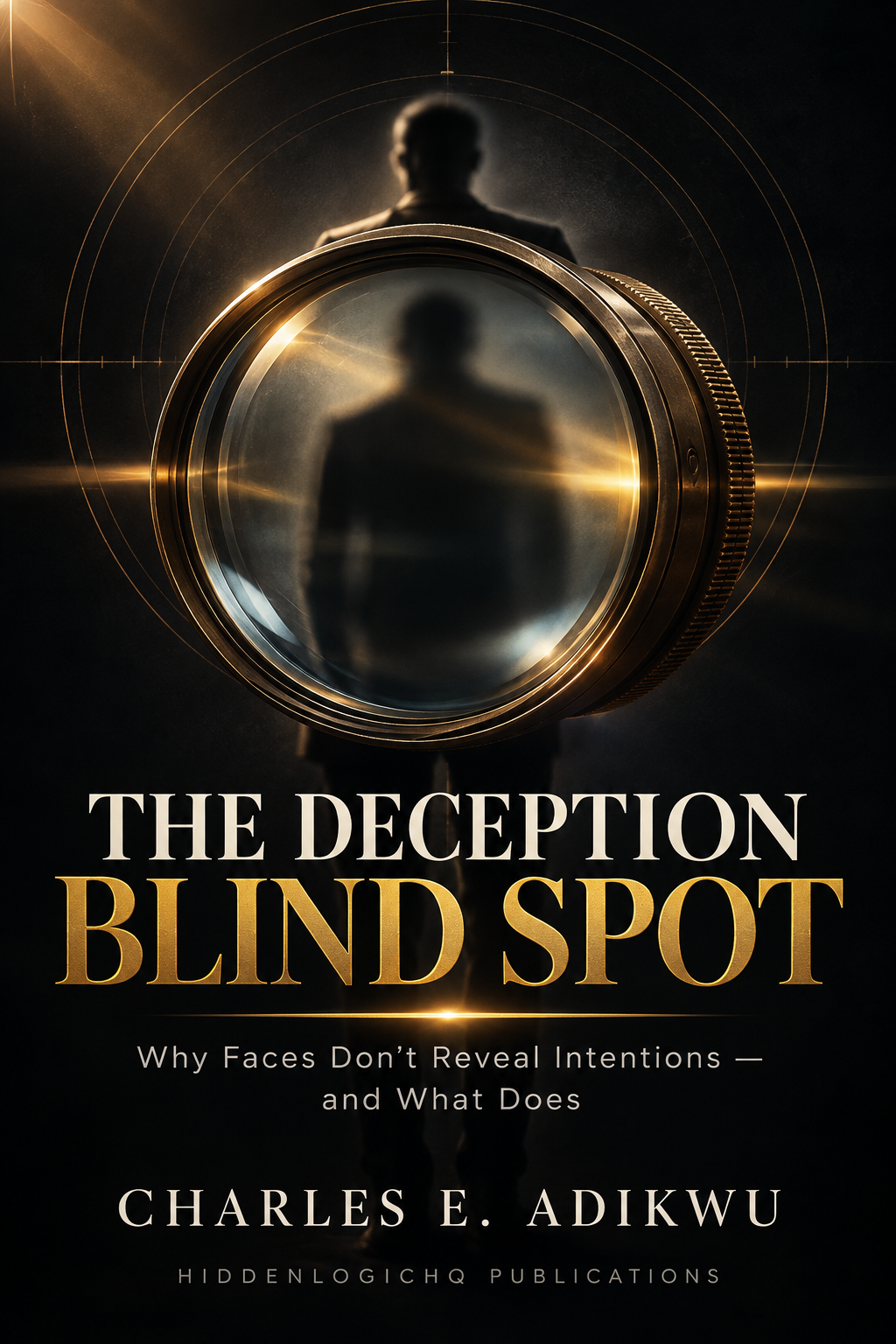
Instant digital download • Written by Charles E. Adikwu
You did not miss the signal. There was no signal to miss.
Across roughly two hundred studies involving about twenty-four thousand people, the average human accuracy at distinguishing lies from truths is only 54 percent. A coin gets 50. Police officers, judges, customs officials, and psychiatrists perform at approximately the same level as everyone else. What they have that others lack is not accuracy. It is confidence.
The Deception Blind Spot starts by dismantling the belief that you can read intentions from faces, body language, or arousal. That belief is not only wrong — it is dangerous. It makes people stop checking, stop verifying, and start accusing. Roughly half the harm in this subject falls on the innocent.
The book then replaces that false ability with methods that actually work.
Lies Are Rarely Caught by Observation
Lies are rarely caught by observation. They are caught by information: a record that contradicts an account, a claim that dissolves when someone finally checks it, a promise measured against what actually arrived. That is a different activity from watching a face, and it has one enormous advantage — it works. It is also a skill that improves with practice.
What You Will Learn
- Why human accuracy at detecting deception from behavior sits near chance
- Why professionals are no better than the rest of us (they are only more confident)
- What facial expressions and physiological arousal actually tell you (and what they do not)
- How to build a proper baseline — and why most people use the idea incorrectly
- How to sort claims by whether they can be checked, then check them
- How to ask questions that are hard to answer falsely
- How to hold what you already know so an account can be tested against it
- How to measure people by delivery over time rather than by presentation
- The real cost of being wrong about someone, and how to keep that cost low
- How to decide well when certainty is unavailable
What’s Inside
10 practical chapters organized into three clear parts. Diagnostic principles and tactical moves you can apply immediately. Composite real-world examples from hiring, partnerships, and high-stakes decisions. Clear ethical lines throughout. A Tactical Glossary and Research Notes grounded in the published evidence.
What Changes When You Apply This
Stop relying on face-reading and body-language folklore
Improve the quality of information you gather about people
Ask better questions that expose weak claims
Structure decisions so being wrong is survivable
Reduce the risk of false accusation
Replace confidence with methods that actually work
This Book Is For
- Professionals who hire, negotiate, or form partnerships.
- Anyone who has paid a real cost for trusting the wrong person.
- Readers who want practical methods grounded in research rather than popular deception-detection myths.
It will not teach you to read faces. It will teach you to stop relying on an ability you do not have, and to build the ones you can.
The Central Idea
You cannot reliably detect deception from faces or body language.
You can dramatically improve the quality of the information you gather and the decisions you make with it.
That is the whole argument of this book.
About the Author
Charles E. Adikwu writes about human behavior, decision-making, and the psychology beneath ordinary social interaction. His work takes research that usually stays inside academic journals and translates it into methods people can apply in hiring decisions, negotiations, partnerships, and difficult conversations. The Deception Blind Spot completes a set of three with The Architecture of Influence and Invisible Armor. He publishes under the HiddenLogicHQ Publications imprint.
This book is for anyone who has been deceived and then spent time searching for the signal they missed.
Instant access • Digital download • HiddenLogicHQ Publications